Most conversations about “AI in design” today remain stuck at the superficial level: generating placeholder text, making moodboards, or chatting with an LLM in a sidebar.
In real-world enterprise product design, that paradigm falls apart immediately. Real product design is constrained by design tokens, WCAG AA contrast mathematics, strict framework lifecycles, and cross-team developer adoption.
The true breakthrough is not chatbots—it is Agentic Coding.
What is an Agentic Pipeline?
An agentic pipeline does not simply answer a question; it executes a multi-step objective within a bounded, verifiable environment:
- State Inspection: Querying a source of truth (e.g. Figma REST API, token dictionaries, or AST vector trees).
- Context Synthesis: Understanding the cross-stack constraints (e.g., transforming a token into React MUI themes, Angular SCSS maps, and Blazor C# structs simultaneously).
- Execution & Refactoring: Generating the code changes, validating them against linter rules, and verifying build integrity.
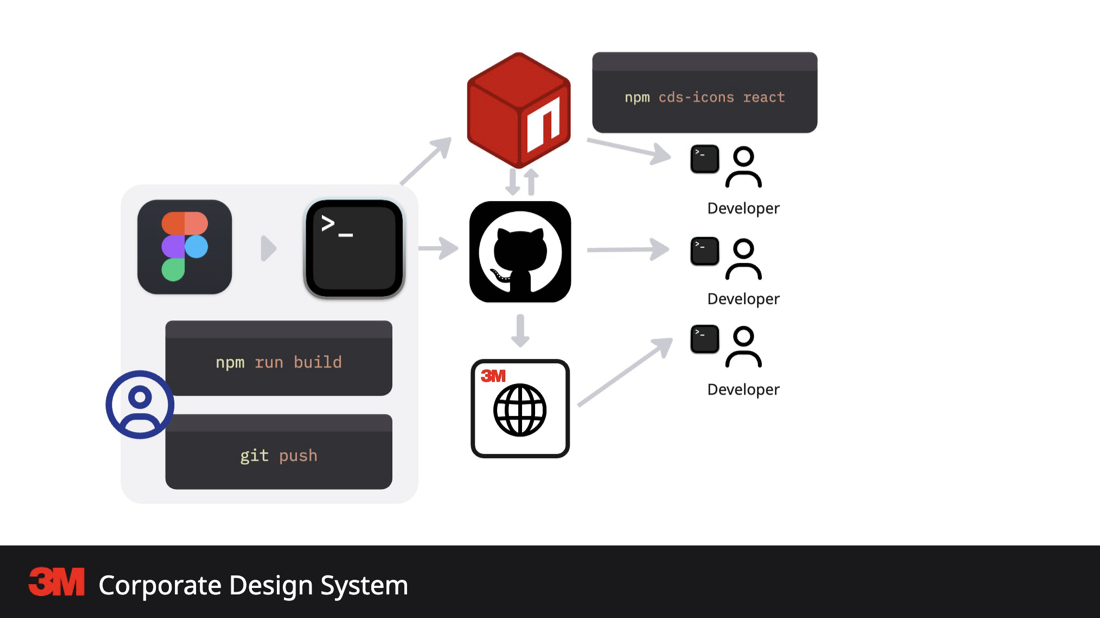
- Autonomous Deployment: Running test suites and packaging the result into versioned npm releases.
flowchart LR
    A["Figma Token Updates"] --> B["Figma MCP & REST API"]
    B --> C["Agentic Synthesis Engine"]
    C --> D["MUI / React"]
    C --> E["Angular Material"]
    C --> F["Material.Blazor"]
    D & E & F --> G["Automated CI/CD Validation"]
    G --> H["npm Registry Release"]
Where Human Craft Fits
Does agentic coding replace the designer? Absolutely not.
It frees the designer from acting as a “human API router.” When I don’t have to spend 6 hours manually re-exporting SVG assets, renaming files, and creating pull requests for 12 sub-brands, I can spend that time where human judgment is irreplaceable:
- Interviewing engineers about adoption friction.
- Crafting clear mental models and spatial UX for complex tools.
- Making the difficult, high-stakes trade-offs between speed and governance.
The future belongs to designers who think in systems and build agentic collaborators to enforce those systems at scale.